
Uncertainty Breakdown Structure
In the PMBOK, uncertainty is described as a lack of understanding and awareness of issues, events, path to follow, or solutions to pursue. In other words, if the initiative we undertake is sufficiently unique and we lack detailed knowledge or understanding of how to execute it, we are operating in a state of uncertainty and must apply project management methods and tools to reduce it. Conversely, if everything is known—supported by data, experience, and established practices—then, in principle, formal project management is not required, and routine operational management may be sufficient.
However, uncertainty is more multifaceted than it may initially appear and can be divided into three categories that together encompass all aspects of project management:
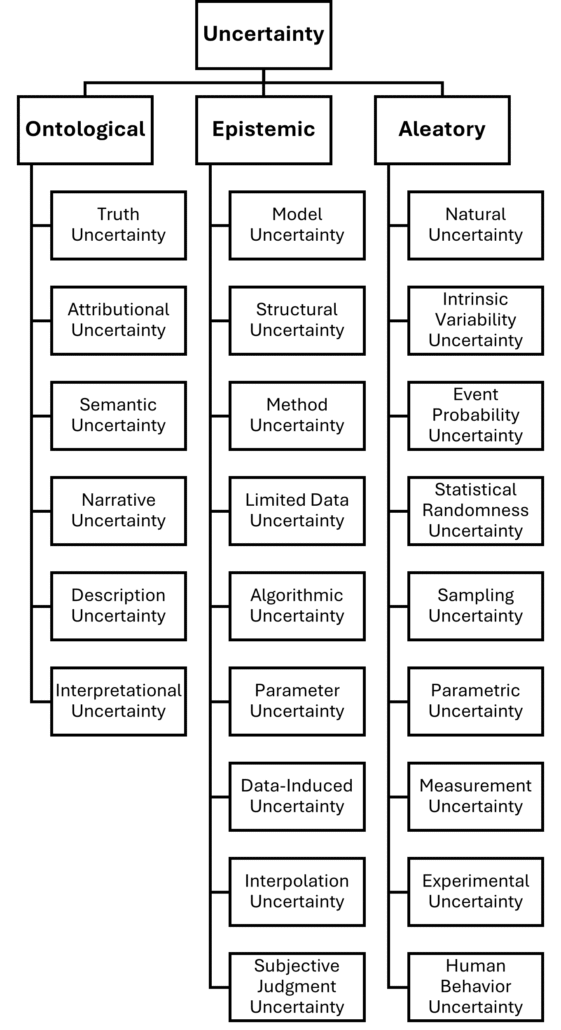
- Ontological (existential) uncertainty
- Epistemic (knowledge-based) uncertainty
- Aleatory (random) uncertainty
Each category represents a distinct dimension of uncertainty, reflecting the diverse nature and origins of unknowns that challenge understanding and predictability.
Within these categories, various subcategories further specify particular types of uncertainty that can affect understanding and decision-making in project management. By structuring these categories and subcategories, a comprehensive Uncertainty Breakdown Structure (UBS) can be developed to assess different manifestations of uncertainty, thereby improving the ability to identify and systematically address uncertainty-related challenges.
1. Ontological Uncertainty
The term “ontological” comes from the Greek words “οντος,” meaning “being” or “that which exists,” and “λογος,” meaning “study” or “science.” Ontology, therefore, is the study or doctrine of being, encompassing the philosophical investigation of the nature, essence, and fundamental problems of existence. It is a core branch of philosophy that seeks to clarify the essential aspects of reality, the nature of entities, and the frameworks through which existence is understood.
Ontological uncertainty arises from the unconscious use of inappropriate methodologies or belief systems. It is unrecognized, not subject to quantitative measurement, and involves scenarios where the entities and interactions of concern are not fully known or understood. This category of uncertainty creates significant challenges, as it involves navigating and identifying new or previously unrecognized elements, domains, or contexts. Thus, it requires categorization, dealing with fundamental questions about existence, and understanding of entities and their relationships. The complexity of ontological uncertainty lies in its deeply rooted connection to the essence of what is being studied and is often not amenable to direct measurement or quantitative assessment.
In project management, ontological uncertainty implies doubt regarding the fundamental purpose, role, and existential impact of the project. This requires consideration of why the project is being implemented and what its ultimate goals are beyond immediate practical execution. This category of uncertainty compels project managers to align project objectives with strategic visions and long-term consequences, often involving profound existential and strategic considerations that go beyond short-term goals and frequently beyond the authority of project teams. It demands a fundamental understanding of the project’s meaning and its place within the broader organizational context, necessitating engagement with complex decision-making processes concerning the very nature and purpose of the initiative. This reflection on the existential dimensions of the project ensures that it is not only feasible but also meaningful within its broader organizational and societal structure.
Through analysis of publications and materials, as well as consultations and discussions with experts, the authors of this article has decided to distinguish six subcategories of ontological uncertainty:
1.1. Truth Uncertainty
Truth uncertainty encompasses the difficulties in determining the accuracy or veracity of assumptions and propositions in various contexts. This uncertainty arises when it is unclear whether the foundational beliefs or data are accurate, leading to challenges in verifying the assumptions underlying decisions and strategies. The main issue of truth uncertainty lies in ensuring that actions are based on reliable and validated information, as relying on questionable premises can result in ineffective or erroneous outcomes. Addressing this uncertainty requires rigorous verification and evaluation processes to confirm that assumptions and propositions accurately reflect reality, thereby reducing the risk of significant errors or strategic misalignments in various fields.
In project management, truth uncertainty can significantly affect how strategies are formulated and implemented. It requires project managers to critically analyze the assumptions underlying their plans and establish robust verification processes to assess their reliability. Decisions must be continually reviewed to ensure alignment with validated truths, and it may be necessary to develop contingency plans to address potential discrepancies between assumptions and actual conditions. Such vigilance promotes informed decision-making and increases project resilience by reducing the risk of basing strategies on unverified or inaccurate premises.
1.2. Attributional Uncertainty
Attributional uncertainty involves ambiguity in assigning or understanding the roles, identities, and responsibilities of various objects or agents within a system or domain. This category of uncertainty may arise when there is a lack of clarity regarding who or what is responsible for specific outcomes, changes, actions, or decisions in the system. Issues associated with attribution uncertainty include potential confusion about accountability, difficulties in coordinating actions, and challenges in effectively evaluating performance or results. Addressing attributional uncertainty requires clear communication, well-defined roles, and agreement among stakeholders to ensure proper allocation and effective management of responsibilities.
In project management, attributional uncertainty can lead to ambiguity regarding the roles of team members, stakeholders, or organizational units. This ambiguity may result in overlaps or gaps in responsibilities, affecting communication, coordination, and accountability. To cope with this uncertainty, project initiators must ensure that roles and responsibilities are clearly defined and communicated to all involved parties, particularly sponsors and project owners. Effective solutions may include the creation of detailed project role descriptions, the establishment of clear authorities, and the creation of forums for ongoing clarification to prevent misunderstandings.
1.3. Semantic Uncertainty
Semantic uncertainty arises from ambiguity and lack of clarity in meanings and definitions during communication. This uncertainty occurs when different participants assign different meanings to the same terms, phrases, or actions, often due to differences in experience or perspectives. The issues it presents include potential misunderstandings and misinterpretations, which can hinder effective communication and collaboration. Addressing semantic uncertainty involves improving terminology, ensuring shared understanding, and fostering clear communication among participants to avoid discrepancies in interpretation.
In project management, semantic uncertainty can lead to misunderstandings and misalignment of objectives if team members interpret key terms or project requirements differently. This can affect everything from goal setting to task execution and outcome evaluation. To mitigate semantic uncertainty, project management offices (PMO) and project managers should prioritize establishing a common language and mutual understanding within the team. Methods such as glossaries, standardized documentation, and alignment meetings can be helpful. Additionally, ongoing communication and feedback cycles help ensure that all team members interpret terms and concepts consistently, reducing the risk of errors and inefficiency due to misinterpretation.
1.4. Narrative Uncertainty
Narrative uncertainty revolves around the use of storytelling and narrative structures to comprehend complex, unpredictable situations. It recognizes that in the face of unforeseen outcomes, embedding decisions and processes within coherent narratives can provide direction and context, helping individuals and teams navigate uncertainty. This form of uncertainty enables the understanding of complex interactions that cannot be immediately anticipated, and supports focus and adaptability by creating stories and ideas that make sense in changing circumstances. The main challenge with narrative uncertainty lies in ensuring that narratives accurately reflect reality and provide meaningful guidance amid inherent unpredictability.
Narrative uncertainty uniquely affects project management by shaping how projects are explained and understood through storytelling. It allows project managers to use descriptive structures to ensure coherence and alignment within teams, especially when facing uncertain outcomes or complex situations. By developing stories that encompass project goals, strategies, and actions, business analysts and project managers can maintain team focus and adaptability. These narratives help translate abstractions or project details into an understandable and interconnected context, ensuring that all stakeholders remain informed and aligned with the project’s direction, fostering resilience and shared understanding of the project’s path despite uncertainty.
1.5. Description Uncertainty
Description uncertainty relates to issues associated with the interpretation and representation of the fundamental nature or form of models or phenomena. It arises when there is a lack of clarity or knowledge about the underlying science or mechanisms governing data and system behavior. This uncertainty becomes particularly evident when the available data do not clearly indicate a single model or when multiple potential models exist, each offering different interpretations. The main challenge of description uncertainty lies in accurately developing mechanistic understandings and causal explanations, which influence the fundamental comprehension and interpretation of observed phenomena.
Description uncertainty affects project management by complicating the precise definition and modeling of project goals and systems. It arises when there is no clarity regarding fundamental processes or when multiple interpretations of the same data or phenomena exist. This influences how project objectives are set and strategies are determined. Project managers must be flexible and open to revising models and strategies as new data or interpretations emerge. This adaptability is crucial for ensuring that the project remains aligned with its ultimate objectives, despite changes in understanding. Addressing this uncertainty requires iterative assessments and diverse perspectives to refine project plans and improve the understanding of system complexity.
1.6. Interpretational Uncertainty
Interpretational uncertainty arises when there are inconsistencies in extracting meaning from data or models due to unclear or inconsistent decoding methodologies. This category of uncertainty is related to the accuracy and consistency in interpreting known information, rather than the discovery or definition of new entities. The main issue associated with interpretational uncertainty is ensuring that data or model outputs are understood in the same way by different interpreters, minimizing discrepancies that can lead to inconsistent interpretations and incorrect decisions. This category of uncertainty highlights the importance of establishing clear, consistent methodologies for data interpretation.
In project management, interpretational uncertainty can affect how project inputs and reports are understood and acted upon. If team members apply different methodologies or criteria for interpreting project information, discrepancies in understanding may arise, potentially leading to inconsistent actions and decisions. Project managers can mitigate this uncertainty by standardizing interpretation methodologies, providing clear guidance on data analysis, and ensuring thorough training and communication regarding these standards. By applying a consistent approach to interpretation, project teams can reduce errors and inefficiencies and ensure that all participants have a shared understanding of project data and outcomes.
2. Epistemic Uncertainty
The term “epistemic” comes from the Greek word “επιστημη,” meaning “knowledge” or “science.” It is fundamental in ancient philosophy, reflecting the pursuit of understanding, cognition, and systematic investigation of what is known. Epistemology is the branch of philosophy that studies the nature, origin, and limits of human knowledge.
Epistemic uncertainty, also known as systematic uncertainty, refers to aspects that could, in principle, be known but are currently unknown. This uncertainty arises from incomplete models or deliberately concealed data. It reflects the gaps and limitations in our current understanding of or information about a phenomenon or system. Addressing epistemic uncertainty involves identifying and filling these knowledge gaps through better data collection and improved models. The task is to acknowledge and recognize these gaps and actively work to reduce uncertainty by increasing the reliability of the data and models used to understand complex systems.
In project management, epistemic uncertainty significantly affects decision-making and strategic planning processes. It arises from a lack of knowledge or incomplete information, which directly impacts how projects are conceived, planned, executed, and evaluated. Managing epistemic uncertainty requires project managers to be clearly aware of knowledge gaps and to continuously seek improvement and refinement of their models and assumptions. This may involve gathering additional data, enhancing analytics, and revising project assumptions as more information becomes available. Project managers should also employ flexible approaches that adapt to new insights, ensuring that changes in knowledge do not derail the overall project objectives. Successfully overcoming epistemic uncertainty involves utilizing learning processes and iterative improvement to make more informed and resilient project decisions.
Through analysis of publications and materials, as well as consultations and discussions with experts, the authors of this article have decided to distinguish nine subcategories of epistemic uncertainty:
2.1. Model Uncertainty
Model uncertainty refers to doubts and issues related to the selection and validation of the correct model for accurately representing a real-world system. This category of uncertainty arises when there is uncertainty about whether the chosen model is appropriate or sufficient to capture the complexity and dynamics of the system under study. Issues of model uncertainty include potential inaccuracies in predictions and decisions based on these models, as they may not fully or correctly reflect system behavior. It is important to recognize that model uncertainty encompasses the entire process of selecting, implementing, and validating models, so it is crucial to ensure regular review and updating of selected models to reflect new data and insights.
In project management, model uncertainty can significantly affect decision-making and schedule development. Choosing an inappropriate model can lead to suboptimal strategies, erroneous forecasts, and misallocation of resources. To manage model uncertainty, project managers should engage in thorough model selection processes, ensure ongoing model validation, and remain open to incorporating new findings and technologies into existing models. Collaborative processes that incorporate diverse knowledge and perspectives can help assess model adequacy. Additionally, applying flexible methodologies that allow the model to be adapted as more information becomes available can help mitigate the effects of model uncertainty, resulting in more robust and adaptive project execution.
2.2. Structural Uncertainty
Structural uncertainty refers to inadequacy or bias in models that arises from incomplete or inaccurate knowledge of the underlying physics or phenomena they attempt to represent. This uncertainty occurs when models are unable to capture the complexity or true nature of real-world systems, often due to simplifications or assumptions made during the construction of the model structure. Issues related to structural uncertainty include potential inaccuracies in predictions and insights provided by the model structure, as these may not fully account for all variables or processes affecting the system. Since models are approximations of reality, this uncertainty highlights the need for continuous improvement and validation of models to enhance the representation of complex systems.
In project management, structural uncertainty can affect how projects are planned and executed, especially when structural models or simulations are used for decision-making. If the underlying project models are biased or misrepresent actual conditions, this can lead to incorrect strategies and/or inefficient execution. To manage structural uncertainty, project managers should engage in ongoing model validation and adaptation, incorporating new data and insights to better align models with reality. This often involves interdisciplinary collaboration and leveraging advances in computational techniques for continuous model improvement. Ensuring that models accurately reflect the systems they are intended to represent helps project managers make more informed and reliable decisions, ultimately improving project outcomes and reducing the risk of strategic errors.
2.3. Method Uncertainty
Method uncertainty is related to the selection and implementation of computational methods used for parameter estimation and forecasting in models. This uncertainty arises when the chosen methods and their implementation potentially introduce variability or inaccuracies, affecting the reliability of the results. The main issue with method uncertainty is its direct impact on analysis outcomes, as the methodological choices made can significantly influence the reliability of forecasts and estimates. Ensuring the correct selection and proper application of computational methods is crucial for achieving accurate and trustworthy results.
In project management, method uncertainty can affect how decisions are made, especially when analysis or forecasting relies on certain methodologies. If the chosen method is unsuitable for the context or poorly implemented, this can lead to biased or inaccurate results, impacting project strategies and outcomes. To address this uncertainty, project managers should carefully assess the suitability of different methods for the needs and objectives of a particular project. Regular review and validation of methods, as well as incorporating expert opinions and benchmarking against other standards, can help ensure the integrity and reliability of project analysis, ultimately leading to more informed and effective decision-making.
2.4. Limited Data Uncertainty
Limited data uncertainty arises from insufficient or absent data, which restricts the ability to make accurate and well-substantiated conclusions about the system. This category of uncertainty is particularly challenging when dealing with new or exploratory fields where comprehensive datasets have not yet been developed. The main issue with limited data uncertainty is that it can hinder the accuracy and reliability of models and analyses, leading to less confident decision-making. Incomplete data may result in models failing to capture the full complexity or variability of the system, making conclusions less reliable.
In project management, limited data uncertainty can affect planning, resource allocation, and risk assessment. When data are scarce, project managers may face challenges in forecasting project outcomes or accurately estimating timelines and costs. To mitigate this uncertainty, project managers should prioritize data collection, encourage iterative cycles of data gathering and analysis, and use expert judgment or proxy data when necessary. It is crucial to employ adaptive management strategies that allow for adjustments as new data become available. By proactively addressing limited data uncertainty, project managers can improve their ability to make informed, flexible decisions and enhance overall project execution and outcomes.
2.5. Algorithmic Uncertainty
Algorithmic uncertainty arises from numerical approximations and errors introduced by computational algorithms used in models. As numerical and statistical models become increasingly complex to realistically represent real-world systems, it is often necessary to compromise between computational cost and model accuracy. This may involve using simpler algorithms with lower computational expense, which can introduce errors into the modeling process. The challenge with algorithmic uncertainty is to balance accuracy and computational efficiency, ensuring that errors from numerical approximations do not significantly affect the accuracy or reliability of the model.
In project management, algorithmic uncertainty can impact project outcomes, especially when project decisions rely on simulation models or computational forecasts. Decisions made using models that involve algorithmic approximations may sometimes overlook important details due to numerical errors. To address this issue, project managers can implement verification processes to assess and minimize the impact of algorithmic errors on outcomes. It is crucial to choose appropriate computational methods, such as Monte Carlo, that balance accuracy and computational efficiency. Additionally, integrating more robust verification and sensitivity analysis processes can help identify and mitigate significant algorithmic uncertainty, thereby increasing the reliability of model-based decisions in projects.
2.6. Parameter Uncertainty
Parameter uncertainty[1] arises when the values of model parameters are specified with inaccurate knowledge or lack of direct measurements. This category of uncertainty pertains to the specific values required for model parameters, which may be unknown, poorly estimated, or derived from insufficient data. Issues related to parameter uncertainty include potential inaccuracies in model predictions and decisions made using these models. Without accurate parameter values, models may not accurately represent reality, leading to errors and inefficiencies in various applications. Reducing parameter uncertainty usually involves obtaining more precise data, improving measurement methods, and using statistical techniques for better estimation.
In project management, parameter uncertainty can significantly affect the accuracy of forecasts, resource allocation, and strategy development. Inaccurate parameter values can lead to errors in budgeting, planning, and risk assessment. Project managers can reduce parameter uncertainty by ensuring continuous data collection and refinement processes, employing advanced statistical methods to improve parameter estimation, and engaging subject matter experts to validate parameter assumptions. This may also include conducting sensitivity analysis to understand the impact of parameter variability on model outcomes.
[1] Do not confuse with “parametric uncertainty.” Although both categories relate to uncertainties associated with model parameters, parameter uncertainty is epistemic and concerns the accuracy of known parameters, whereas parametric uncertainty is aleatory, dealing with the natural variability inherent in the system’s input variables.2.7. Data-Induced Uncertainty
Data-induced uncertainty is a category of uncertainty that arises from decisions made during the selection, cleaning, and transformation of input and output data. This uncertainty affects the clarity, consistency, and reliability of the data used in models or analyses. The problem with data-induced uncertainty lies in ensuring that these data processing decisions do not inadvertently introduce bias, errors, or inconsistencies that can distort results and conclusions. Maintaining data integrity and accuracy throughout the entire lifecycle requires careful data management practices.
In project management, data-induced uncertainty and poor data handling practices can lead to inaccurate project assessment and strategy development. To manage this uncertainty, project managers should implement rigorous data governance frameworks, ensuring transparent and consistent processes for data selection, cleaning, and transformation. This may involve using standardized protocols for data handling, training team members in best practices, and conducting ongoing validation checks to ensure data quality and reliability. By addressing data-induced uncertainty, project managers can enhance the credibility of their analyses, leading to more informed and effective project strategies and decisions.
2.8. Interpolation Uncertainty
Interpolation uncertainty arises when missing data in a model simulation or experimental dataset are filled using interpolation algorithms, which can introduce errors or noise. This category of uncertainty is associated with the challenges of accurately predicting or estimating values for data points that have not been directly observed or measured. The main issue lies in the potential inaccuracies that may result from using algorithms to estimate these values, which may not fully capture the complexity or variability of the real-world system being modeled. Consequently, interpolated data may contribute to biased or unreliable model forecasts.
In project management, interpolation uncertainty can affect the reliability of forecasts or analyses when datasets are incomplete. Decisions that depend on interpolated data may be based on estimates that do not adequately reflect actual conditions, leading to potential errors in planning or execution. To manage interpolation uncertainty, project managers should ensure robust data collection processes to minimize the need for interpolation. Additionally, they should carefully select and validate interpolation algorithms, using sensitivity analysis to understand their impact on project decisions. By recognizing the limitations of interpolated data and implementing validation checks, project managers can improve the accuracy and reliability of project insights and strategies.
2.9. Subjective Judgment Uncertainty
Subjective judgment uncertainty arises from biases and variability originating from human decisions and expert opinions during modeling or decision-making processes. This uncertainty results from personal or expert influence rather than technical or data-driven factors and can affect the outcomes of models or strategies through bias or variability. Two subtypes of subjective judgment uncertainty include moral uncertainty and rule uncertainty:
- Moral uncertainty involves situations where applicable moral rules are absent, prompting decision-makers to rely on broader, generalized moral principles to guide their choices. These scenarios often lead to decisions that may not fully satisfy or resolve the specific ethical dilemmas encountered.
- Rule uncertainty pertains to decisions made based on intuition rather than established rules. Here, choices are guided by internal moral beliefs and experiential knowledge, sometimes resulting in actions shaped by intuition in the absence of clear rules or guidelines.
The main issue with subjective judgment uncertainty is that it can lead to inconsistent or biased conclusions that rely on individual interpretation rather than standard frameworks.
In project management, subjective judgment uncertainty can influence decision-making processes, especially where expert opinions and judgments guide project strategies. This can result in variability or bias, affecting the consistency and reliability of project outcomes. To counter this uncertainty, project managers can incorporate diverse perspectives and foster an environment where critical evaluation and validation of expert opinions are standard practice. Establishing a decision-making system that is transparent and supported by documentary justification can reduce bias. Additionally, awareness of moral uncertainty and rule uncertainty enables managers to effectively incorporate ethical discussions and intuitive ideas, ensuring that personal biases do not affect project objectives and the objectivity of decision-making.
3. Aleatory Uncertainty
The term “aleatory” comes from the Latin word “alea,” meaning “chance” or “dice,” and refers to the concept of risk or randomness inherent in games of chance. In the context of uncertainty, “aleatory” is associated with random processes, emphasizing the inherent variability and unpredictability of certain phenomena. It highlights the randomness of processes whose outcomes cannot be precisely determined or reproduced due to intrinsic variability.
Aleatory uncertainty, also known as stochastic uncertainty, chaotic uncertainty, or uncertainty of inherent variability, describes a category of uncertainty that arises from the intrinsic randomness present in natural processes. It encompasses unknowns that change with each repetition of an experiment or observation due to factors such as environmental conditions, equipment performance, human behavior, or natural fluctuations. This uncertainty is often characterized using probability distribution functions, reflecting its irreducible nature — it cannot be eliminated even with more precise measurement tools. The challenge of aleatory uncertainty lies in its inherent unpredictability, which requires probabilistic modeling and analysis methods, where decisions are made based on statistical probability rather than deterministic outcomes.
In the field of project management, aleatory uncertainty affects phases where inherent variability and unpredictability are paramount, such as during the execution or operational phase. Project managers must account for this randomness in their plans and forecasts, knowing that certain aspects of the project, such as timelines, resource availability, or environmental conditions, may change unexpectedly. To manage aleatory uncertainty, project teams often employ various risk management strategies, using statistical and probabilistic models to anticipate potential deviations and develop contingency plans for likely and unforeseen circumstances. While precise control over random variability is impossible, understanding and preparing for its impact can help mitigate its effects on project outcomes, maintaining flexibility and the ability to respond to unforeseen changes.
Through analysis of publications and materials, as well as consultations and discussions with experts, the authors of this article have decided to distinguish nine subcategories of aleatory uncertainty:
3.1. Natural Uncertainty
Natural uncertainty represents the inherent randomness and variability of natural, social, and economic processes. This category of uncertainty is caused by spatial and temporal heterogeneity, highlighting how natural systems and phenomena inherently fluctuate in unpredictable ways. Natural uncertainty is considered irreducible, meaning it cannot be eliminated through additional data collection or improved equipment, although it can be better understood through enhanced quality and quantity of observations. The main issue associated with natural uncertainty is the inability to accurately predict or control these stochastic fluctuations, which requires strategies that account for and adapt to such unpredictability.
In project management, natural uncertainty can significantly impact projects sensitive to social, environmental, political, or economic conditions, such as construction, agriculture, or energy production. This compels project managers to incorporate flexibility and adaptability into their plans, considering the inherent unpredictability of natural systems. This may include developing robust risk management strategies that incorporate contingencies for likely circumstances, such as changes in weather conditions or economic fluctuations. By recognizing and planning for natural uncertainty, project managers can enhance the resilience of their projects, ensuring operational effectiveness and the achievement of objectives even in the face of unpredictable external variables.
3.2. Intrinsic Variability Uncertainty
Intrinsic variability uncertainty concerns natural fluctuations and inherent variabilities present in the state of a system. This category of uncertainty arises due to factors such as variations in material properties or economic conditions, such as market demand and interest rates. These fluctuations are an integral part of the system’s state, making them uncontrollable and inevitable. The main issue lies in their unpredictability, which can lead to significant fluctuations in outcomes even under unchanged conditions.
In project management, intrinsic variability uncertainty affects how projects deal with unpredictable social or economic factors. For example, in industries such as finance or manufacturing, where market conditions or consumer behavior can vary greatly. Project managers can manage this uncertainty by incorporating flexibility into their planning processes, allowing for adaptive responses to these variable states. This may include developing contingency plans, establishing adaptive performance indicators, and ensuring that supply chains or schedules can account for changes.
3.3. Event Probability Uncertainty
Event probability uncertainty focuses on the inherent randomness associated with the dynamics of system events, such as the occurrence of natural disasters or sudden economic changes. This uncertainty highlights the fact that the probability of such impactful events is inherently unpredictable and cannot be determined or reduced through additional information or data collection. This especially complicates the planning of rare but destructive events, as these events can drastically change the system’s dynamics when they occur.
In the field of project management, event probability uncertainty requires a proactive and robust approach to risk management, especially in industries or regions vulnerable to unexpected disruptions. Project teams should develop comprehensive risk mitigation strategies, such as creating disaster recovery plans or implementing insurance schemes to minimize the impact of such events. By maintaining flexibility in project schedules and resource allocation, project managers can enhance the resilience of their system, ensuring rapid recovery after disruptions.
3.4. Statistical Randomness Uncertainty
Statistical randomness uncertainty refers to the inherent randomness observed in data due to the fundamental probabilistic nature of the phenomena being measured. This uncertainty is modeled using probability distributions and highlights the variability that naturally arises in data sets obtained from processes that are fundamentally stochastic. The main issue of statistical randomness is its impact on data analysis and interpretation, as it requires careful consideration to separate true patterns from random noise. Effective management of this uncertainty involves the use of statistical methods that account for and correctly interpret such variability, avoiding misleading conclusions.
In project management, statistical randomness uncertainty affects how data are analyzed and interpreted, influencing decision-making and strategy development processes. Projects that rely on statistical analysis should use robust analytical methods that can properly account for randomness in data sets, ensuring the accuracy and reliability of information. Project managers can mitigate this category of uncertainty by using advanced statistical tools and methodologies, including regular data reviews and maintaining transparency regarding the limitations of the analysis.
3.5. Sampling Uncertainty
Sampling uncertainty is the variability that arises when conclusions about a large population are drawn based on a random sample. This uncertainty occurs due to the possibility that the sample may capture effects that are spatially or temporally transient, may overemphasize or omit certain phenomena, and may inaccurately represent the broader population. This variability typically appears in the term of statistical analysis error. The key issue of sampling uncertainty is to ensure that conclusions drawn from sample data are valid and suitable for generalization to the larger population, which requires careful sample design and analysis methods to minimize bias and errors.
In project management, sampling uncertainty can affect the reliability of project estimates and decision-making processes, especially when project decisions depend on data obtained from samples rather than the entire population. To manage this uncertainty, project managers should ensure robust sampling strategies aimed at representativeness and minimizing bias. This may include using stratified (by focus groups) or random sampling methods and conducting sensitivity analysis to understand how sample variability may affect conclusions.
3.6. Parametric Uncertainty
Parametric uncertainty[2] is associated with the variability inherent in the input variables of models, arising from natural or production inconsistencies that may occur. This category of uncertainty reflects the inherent randomness or variability observed in the modeled components, for example, the dimensions or properties of a manufactured part. This variability can cause significant differences in model performance or system behavior. The problem of parametric uncertainty lies in its irreducibility, as additional data or improved measurements cannot completely eliminate it. It is usually modeled using probabilistic methods to effectively account for this stochastic nature.
In project management, parametric uncertainty can affect project planning and execution, especially when it comes to precise specifications or quality standards. This uncertainty can impact cost estimation, resource planning, and risk management strategies. To manage parametric uncertainty, project managers can apply robust design practices, including variability analysis at the planning stages and using probabilistic modeling to predict potential impacts. By understanding and planning for parameter variability, project teams can better align execution with project requirements, ensuring improved quality control and risk mitigation, thereby increasing project resilience and efficiency.
[2] Not to be confused with “parameter uncertainty.” While both categories relate to uncertainties associated with model parameters, parameter uncertainty is epistemic and concerns the accuracy of known parameters, whereas parametric uncertainty is aleatory, dealing with the natural variability inherent in the system’s input variables.3.7. Measurement Uncertainty
Measurement uncertainty refers to the inherent imprecision and inaccuracy in determining input and output variables due to the limitations of measuring instruments and methods. All measurements depend on unpredictable fluctuations in the measurement process itself. This category of uncertainty can be divided into two types:
- Type A uncertainty, which is assessed using statistical methods, and
- Type B uncertainty, which is assessed by other means, such as assigning a probability distribution.
The main task of measurement uncertainty is to ensure the accuracy and reliability of data, which is crucial for modeling and decision-making processes.
In project management, measurement uncertainty can affect the accuracy of project estimates, quality control, and outcome evaluation. This uncertainty can lead to potential errors in data interpretation, which may result in incorrect strategies or resource allocation. To address measurement uncertainty, project managers should prioritize the use of high-quality, calibrated measuring instruments and methodologies, implement regular verification procedures, and incorporate allowable errors into estimates.
3.8. Experimental Uncertainty
Experimental uncertainty is the variability observed during repeated measurements under identical conditions, arising from the inherent limitations and randomness of experimental methods and instruments. It reflects the inevitable fluctuations in results, even when experiments are conducted multiple times with the same settings. This category of uncertainty highlights the random variability that may occur in experimental processes, making it essentially impossible to reduce through additional knowledge or improved measurements. The main issue of experimental uncertainty is to ensure that the collected data are reliable and accurately reflect the phenomena being studied, despite the limitations of the experimental setup.
In project management, experimental uncertainty can significantly affect projects that rely on testing and prototyping stages, where repeated measurements are crucial for verification and validation. To address this uncertainty, project teams should implement various experimental designs that can account for variability. This can be achieved through multiple assessments of the same function at different review meetings, allowing for a comprehensive understanding of potential variability. Additionally, incorporating statistical analyses that evaluate and account for experimental variability can help derive meaningful insights from test data.
3.9. Human Behavior Uncertainty
Human behavior uncertainty concerns the unpredictable variability of human actions and decisions, which can often be irrational, cause cognitive dissonance, or deviate from expected behavioral patterns. This type of uncertainty stems from the inherent complexity of human nature, where actions may not correspond to stated intentions or standard behavior. Issues related to human behavior uncertainty include difficulties in predicting how individuals or groups will react in certain situations, which can lead to unexpected outcomes and complicate the planning and execution of strategies.
Human behavior uncertainty significantly affects project management, influencing team dynamics, stakeholder engagement, decision-making, and overall project execution. Discrepancies in individual behavior and decisions can result in unpredictability in project progress, potentially causing delays or conflicts. This variability prompts project managers to maintain cohesion and focus within the team, as different reactions to tasks or stress can hinder stable operation. Effective communication and leadership are crucial for mitigating these effects, as they ensure alignment and understanding despite behavioral fluctuations. Additionally, fostering a strong team environment is of great importance, as it helps reduce uncertainty arising from human interaction, ensuring that projects stay on track despite the inherent unpredictability of human behavior.
For more details, see the article “Categories of Uncertainty Affecting Project Management Information Systems.”


Leave a Reply
Want to join the discussion?Feel free to contribute!