

Training on project management “iso.Project”
Based on the international standard ISO 21502:2020 “Guidance on project management“
“Project is a temporary endeavour to achieve one or more defined objectives.”
©2020 International Organization for Standardization. Guidance on project management
This training will guide you through the concepts and methods of ISO 21502 Project Management that are important for and affect the successful implementation of a project. The training enhances your ability to implement projects and provides tools, ideas, and approaches for successful project implementation.
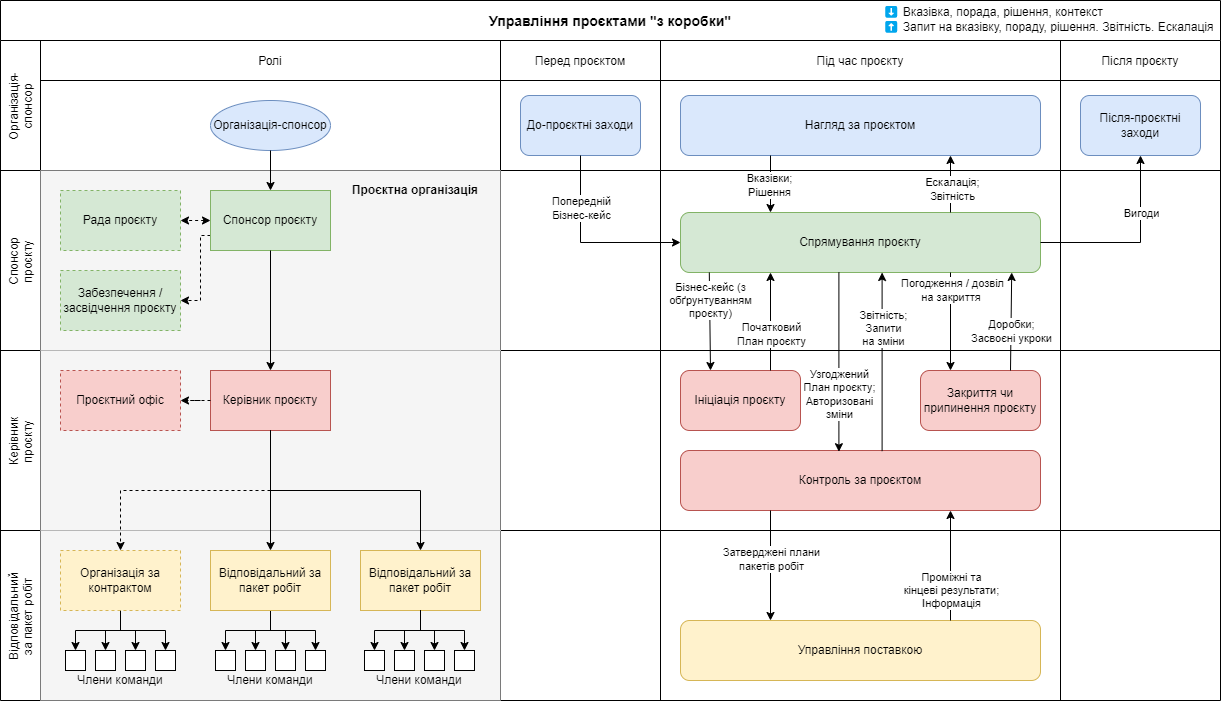
During the training, participants engage in individual and group exercises, working on a project typically related to the customer’s industry. They apply a range of tools, techniques, and methods encompassing various project stages, including pre-project activities, project initiation and direction, control and supervision, delivery management, and project closure or termination. Additionally, they delve into post-project activities, gaining a deep understanding of these tools and learning to apply the principles independently in practical scenarios.
 Instructor: Anatolii Savin, PfMP, M.S.P.M., PMP
- Duration of the training: 2-4 days, 14-28 hours (at the request of the customer, the depth of study of ISO 21502 is changed and industry specifics are imposed)
- Number of participants: 9-15 people (for classroom training) or up to 6 people (for online training)
- Language*: Ukrainian or English
*It can be russian, but there should be no russian citizens in the group and the cost of the training will be 2 times more expensive. The extra money will be sent to the Ukrainian Armed Forces or to rebuild Ukraine.

Advantages of the standard ISO 21502 “Project Management”
Using the recommendations of ISO 21502 for project management, organizations and project managers will be able to:
- Transform your ideas into tangible or intangible products.
- Successfully manage and engage stakeholders during project development and implementation.
- Initiate, plan, implement, monitor, and complete projects with specific goals, scope, and resources.
- Control changes in projects.
- Manage organizational and societal changes that affect projects.
- Conduct project risk assessments and manage identified risks.
- Learn from your own project management events.
The following trainings
Nothing from 14.09.2026 to 14.03.2027.
Target audience
The target audience of this training includes, but is not limited to:
- Senior management to provide a better understanding of project management and help them provide appropriate support and direction to project managers and individuals working on projects;
- Individuals involved in the management, governance, provision, audit, and governance of projects, such as project sponsors, project boards, and auditors;
- Project managers and project team members to have a common framework for understanding, conducting, comparing, evaluating, and communicating the practices used in their project;
- Developers of national or organizational standards, processes, and methods for project management.
In addition, this training may be useful for those involved in project management support:
- governance and management of portfolios and programs;
- program and project offices or similar organizational structures;
- persons engaged in the academic study of project, program, and portfolio management;
- persons performing functions related to project management, such as finance, accounting, human resources, procurement, and legal.
Participants of our training are ready to share their personal experiences:
В период 19-21 февраля 2018 года специалисты и руководство компании ТОО «Ен Даулет» участвовали на тренинге, организованным компанией Expedition Project Management, Украина, на тему «Управление проектами на основе стандарта ISO 21500»... Читать далее >>>

Preliminary requirements
Training participants should first listen to the seminar iso.21500 – ISO 21500 “Context and Concepts” or study independently how the constellation of ISO 21500 series standards is arranged.
Knowledge and skills
 The participants will gain in-depth knowledge of modern project management concepts and terminology. After completing the training, students acquire the following knowledge and skills:
- Develop project goals, concept, business case, charter, life cycle, and WBS.
- Identify and document the criteria for project success and failure.
- Identify the external environment of the project.
- Develop a project schedule and analyze it using the critical path method.
- Identify project milestones.
- Authorize and launch the project for execution.
- Create project reports based on S-curves and a list of milestones.
- Identify project risks and plan responses to risk events.
- Manage with limited team resources and resolve resource conflicts.
- Summarize the results, analyze the lessons learned, and complete projects.
 Additional knowledge and skills can be gained at the following trainings:
- iso.Program – ISO 21503 “Program Management” if you work “in the long run” and need to implement interrelated projects over a long period of time (years).
- iso.Portfolio – ISO 21504 “Portfolio Management” if you are a “big picture” business and need to implement many projects with the most efficient use of limited resources.
- iso.EVM – ISO 21508 “Earned Value Management” if you need to improve reporting and control of projects and programs.
- iso.WBS – ISO 21511 “Work Breakdown Structure” if you need to improve project and program planning and reduce uncertainty in their future implementation.
Topics to be covered
- Project management concepts
- Organizational strategy and projects
- Customer and supplier perspective
- Project constraints
- Projects as stand-alone, part of a programme or part of a portfolio
- Project governance and Governance framework
- Project life cycle
- Project organization and roles
- Competencies of project personnel
- Prerequisites for formalizing project management
- Considerations for implementing project management
- Continuous improvement of the project management environment
- Alignment with organizational processes and systems
- Management practices for a project
- Planning (developing and monitoring the plan)
- Benefit management (identifying, analyzing, monitoring, and maintaining benefits)
- Scope management (defining, controlling the scope, and confirming scope delivery)
- Resources management (planning the project organization; establishing, developing, and managing the team; planning, managing, and controlling physical and material resources)
- Schedule management (estimating activity durations; developing and controlling the schedule)
- Cost management (estimating costs, developing the budget, controlling costs)
- Risk management (identifying, assessing risk, treating, and controlling risk)
- Issues management (identifying and resolving issues)
- Change control (establishing a change control framework; identifying, assessing, planning the implementation, implementing and closing change requests)
- Quality management (planning, assuring, and controlling quality)
- Stakeholder engagement (identifying and engaging stakeholders)
- Communication management (planning communication, distributing information, monitoring the impact of communications)
- Managing organizational and societal change (identifying the need for change, implementing the organizational and societal change)
- Reporting (planning and managing reporting, delivering reports)
- Information and documentation management (identifying which information should be managed, storing and retrieving information and documentation)
- Procurement (planning procurement, evaluating and selecting suppliers, administering contracts, closing contracts)
- Lessons learned (identifying and disseminating lessons)
- Integrated project management practices

- Pre-project activities
- Identification and analysis of benefits
- Identification of risks
- Identification of stakeholders
- Business case
- Directing a project
- Defining a change control framework
- Monitoring of benefits
- Initiating a project
- Initial justification of the project
- Project governance and management approach and plan development
- Defining the scope
- Planning the project organization and creating a team
- Estimating the duration of work and developing a schedule
- Cost estimation and budget development
- Risk assessment
- Quality planning
- Communications planning
- Determining what information should be managed
- Identification of the need for change
- Overseeing a project
- Reporting planning
- Procurement planning
- Supporting benefits
- Confirmation of volume delivery
- Quality control
- Controlling a project
- Progressive elaboration
- Team management
- Monitoring the plan
- Project performance management
- Planning, management and control of physical and material resources
- Volume control
- Schedule control
- Cost control
- Risk control
- Evaluation and selection of suppliers and contract administration
- Reporting management
- Tracking the impact of communications
- Manage the start, progress and closure of each work package
- Manage the start and completion of each phase of the project
- Identify, assess and plan the implementation of change requests
- Managing delivery
- Team development
- Quality assurance
- Identification of circumstances and Resolution of circumstances
- Responding to risk
- Stakeholder engagement
- Providing reports
- Dissemination of information
- Storage and retrieval of information and documentation
- Implementing and closing change requests
- Identifying lessons learned
- Closing or termination of a project and Closing contracts
- Post-project activities
- Dissemination of lessons learned
- Implementation of organizational and social changes
- Pre-project activities
Technical equipment for the training
For classroom training
- Projector and screen.
- Computers with Microsoft Office, Project Professional, Power BI and Internet access.
- Access to the Microsoft Project Online training lab.
- A common workspace (cloud) with training materials and best practices.
For online training on ISO 21502 “Project Management”
The necessary software, hardware, and settings can be found at PMDoc.ua/trainings/on-line
Practical tasks of the training on ISO 21502 “Project Management”
- A preliminary test to assess the initial orientation in project management (to find out the level of preparation of the group and the appropriate presentation of the material).
- Group exercise on project selection (as a cross-cutting example for the entire training), project scaling, and business case development.
- Group exercise to develop a project charter.
- Group exercise on developing a hierarchical work breakdown structure (WBS) for a project.
- An individual and group test to assess team problem-solving in planning the stages of project implementation.
- Group exercise on developing a project schedule and analysis using the critical path method.
- Group exercise to identify project milestones.
- Group exercise on project reporting based on S-curves and a list of milestones.
- Individual and group exercise on identifying project risks and planning response measures to risk events.
- A business game to practice multi-project management skills in the face of limited company resources and resolve resource conflicts.
- A business game to develop skills in understanding customer requirements and delivering a finished project to the customer.
Ordering training on ISO 21502 “Project Management”
To order the training and get additional training advice, please visit the CONTACTS section.
To customize the training and get detailed information about the content, please contact the instructor Anatolii Savin directly:
Phone: +380 (67) 744-4615
E-mail: anatolii@savin.pm
Skype: anatolysavin